


- BY Nor Ibrahim
- POSTED IN Articles
- WITH 0 COMMENTS
- PERMALINK
- STANDARD POST TYPE
Making changes on the factory floor is never simple. Whether adding new machines, rearranging layouts, increasing capacity, or planning a factory expansion, every decision carries cost and risk. Many manufacturers still rely on experience, spreadsheets, or 2D layouts to plan these changes, only to find new bottlenecks, excess work-in-progress, or inefficiencies once production begins. In today’s complex manufacturing environment, assumptions are no longer enough — a single overlooked constraint can ripple across the entire production process.
Factory flow simulation removes this uncertainty. By testing ideas virtually first, manufacturers can see how changes will impact the entire production system before committing resources on the shopfloor. This helps answer practical questions: Will a new machine actually improve output? Will a layout change reduce lead time, or simply move the bottleneck elsewhere? Will adding staff at one station solve delays, or create congestion downstream? Simulation provides clarity and insight, helping teams make decisions with confidence rather than guesswork.
What Is Factory Flow Simulation?

Factory flow simulation creates a digital representation of the factory, including machines, material movement, operators, and process logic. Unlike static layouts or spreadsheets, simulation shows how all the elements interact in real time. Teams can explore “what-if” scenarios — from minor process adjustments to large-scale expansions — without interrupting actual operations.
It’s especially valuable for identifying root causes of recurring challenges. Bottlenecks, high work-in-progress, poor material flow, and uneven resource utilisation often stem from system-wide interactions rather than isolated issues. Simulation helps teams understand these dynamics and make smarter, more efficient decisions.
How DELMIA on 3DEXPERIENCE Supports Factory Planning
DELMIA, powered by the 3DEXPERIENCE platform, enables manufacturers to create a digital twin of the factory and simulate real production behaviour under realistic conditions. Unlike traditional planning methods, DELMIA connects factory planning with product design and manufacturing processes, keeping teams aligned. Engineering, production, and management can collaborate using the same data, test multiple scenarios, and select the most efficient approach before committing resources.
Manufacturers can evaluate layout options, production sequences, and staffing scenarios while monitoring throughput, cycle time, and resource utilisation. This not only reduces risk and improves operational efficiency but also supports strategic decisions such as equipment investment, line expansion, or process automation.
👉 Learn more about DELMIA and how it enables factory flow simulation on the MAWEA website:
https://mawea.com.my/brands/dassault-systemes/delmia/
Plan Smarter with Factory Flow Simulation
Simulation allows manufacturers to plan proactively rather than reactively. By testing scenarios virtually, teams can optimise workflows, reduce bottlenecks, and improve overall efficiency before committing resources. Data-driven insights also help management make informed investment decisions, ensuring capital and operational expenditures are justified. The result is a factory that operates more predictably, efficiently, and with better return on investment.
Seeing factory flow simulation in action makes these benefits tangible. That’s why we’re hosting a webinar focused on factory flow simulation using DELMIA on the 3DEXPERIENCE platform. In this session, you’ll see how simulation identifies bottlenecks early, optimises production flow, and supports smarter, data-driven factory planning.
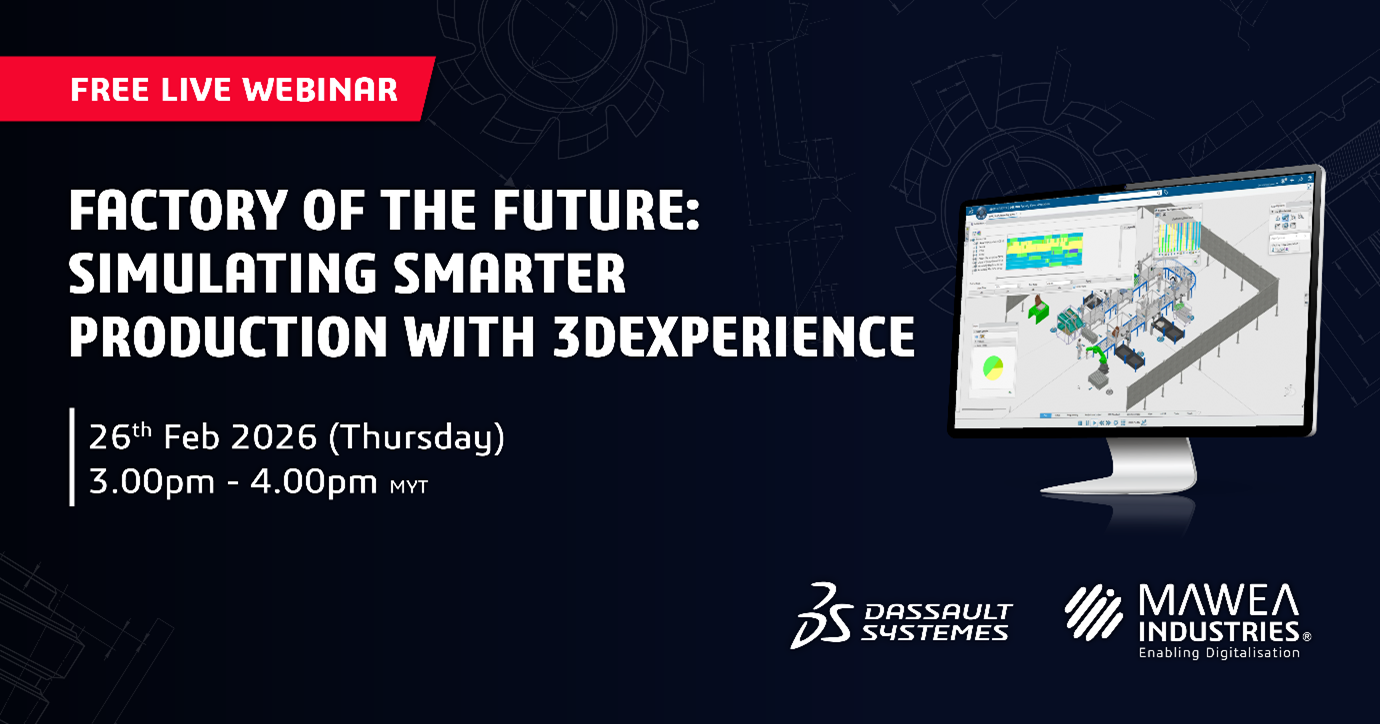
Join our upcoming webinar to experience factory flow simulation in action:
https://bit.ly/3O2v0RB